teaching
Teaching and Outreach - Cultivating the "Maker" Scientist"


A Vision for the Next Generation of Scientists
My personal vision for teaching is centered on stimulating creativity and critical thinking while providing students the freedom to explore curiosity-driven questions. I see high-quality scientific knowledge as a “toolset”, a framework that is necessary, but only useful when applied to problem-solving. In my view, the modern scientist should be a polymath; it is no longer enough to understand a chemical process; one must also know how to 3D design, 3D print, and program microcontrollers to build the sensors and devices required to measure that process. I align my course with the Wageningen University & Research (WUR) mission to explore the potential of nature to improve quality of life. My teaching exists at the intersection of Molecular Lifescience, Biotechnology, Sensing, and Society, training students to develop sensors that track food safety, environmental changes, and health.


Undergraduate Innovation: The “Open Protocol” Approach
In my “Sensors and Devices” course, I have moved away from the traditional “cookbook” style of laboratory education.
Learning Through Failure: I provide “open protocols” rather than step-by-step instructions. This forces students to understand the why behind every reagent and measurement. If an experiment fails, students are not penalized; instead, they are graded on their ability to diagnose the failure and propose a scientific workaround. This transforms the laboratory into a space for genuine research rather than mere reproduction.
Experiments@Home: When the pandemic restricted campus access, I developed the Experiments@Home kit, which was featured in Nature Reviews Chemistry. We shipped boxes containing chemicals, an Arduino, and sensors to students’ homes. This didn’t just solve a logistical problem; it improved the learning path. Students reported that working at their own pace allowed them more time to think deeply about their mistakes. This hybrid approach is now a permanent part of my curriculum, where students build their devices at home and bring them to the university for high-level measurements.
Student Competitions: I mentor teams for the NWO Chemistry Student Challenge (Winners, 2017) and the SensUs International Competition. In 2022, the WUR team took 2nd place globally for analytical sensitivity, demonstrating that undergraduate students can reach professional-grade innovation when given the right motivation and freedom.


Postgraduate & Professional Training: The DIY Lab
For PhD students and professionals, I bridge the gap between “Open Science” theory and “Open Hardware” practice. Many researchers find themselves limited by commercial equipment that is either too expensive or not optimized for their specific needs.
Open Hardware in the Lab: I lead intensive workshops on 3D printing, laser cutting, and CNC milling. I teach participants to go from a sketch to a physical prototype in a single day. This course is designed for PhDs without prior engineering experience, giving them the autonomy to fabricate custom setups that make their experiments faster and more affordable.


Public Outreach: for the next generation of scientists
Science communication is most effective when it is tactile and visual. I use the “Lycurgus Cup” effect to engage the public in the wonders of nanotechnology.
Dichroic Demonstrations: By synthesizing silver and gold nanoparticles that change color based on the angle of light (scattering vs. transmission), I can visually explain complex plasmonic effects to laypeople.
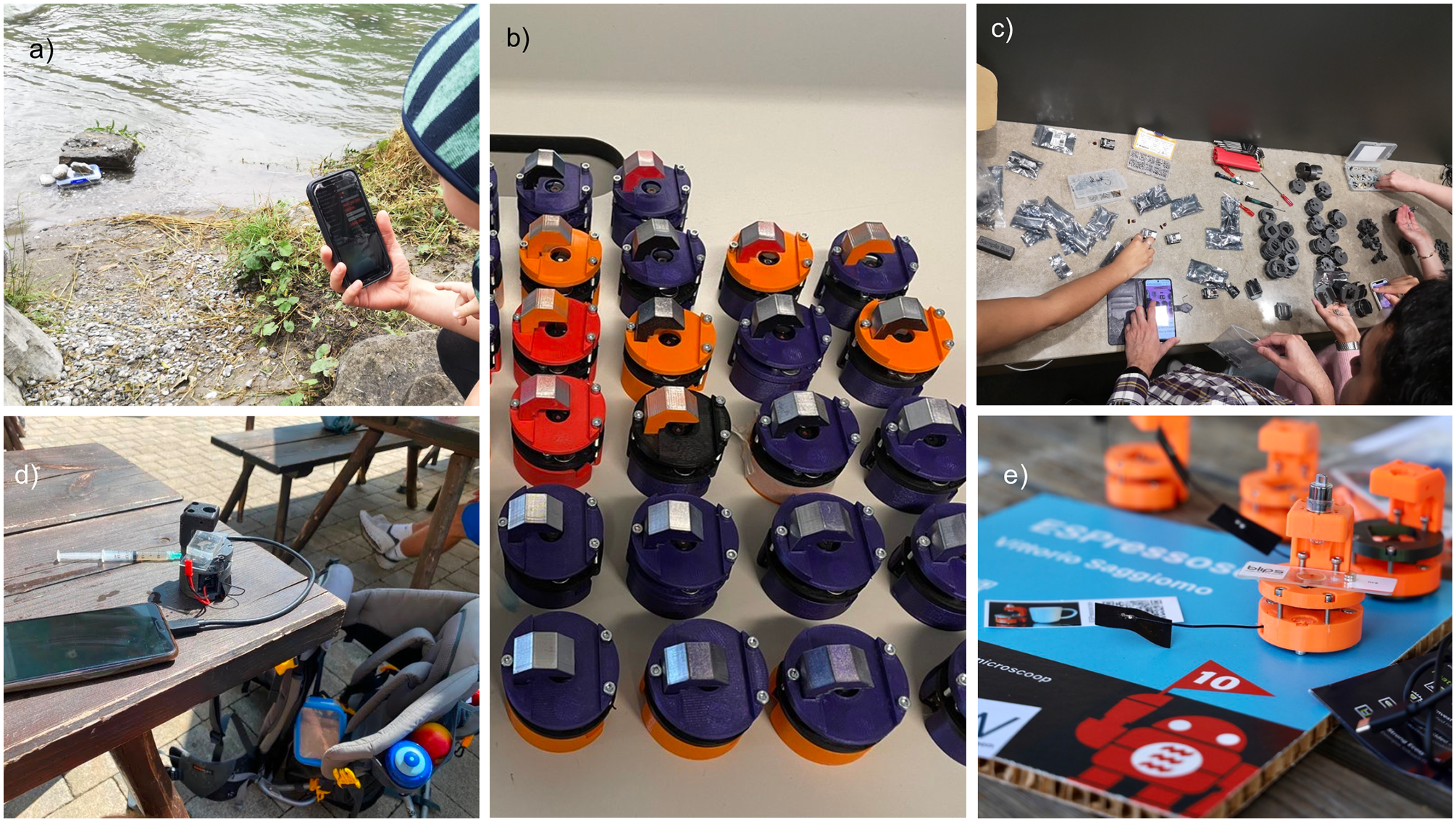
Makerspaces & Festivals: From MakerFaires to Biodiversity Days, I host hands-on sessions where people build their own ESPressoscopes and look for Tardigrades in the environment. By putting a 3D-printed microscope in someone’s hand, I demystify technology and show that science is accessible to everyone, not just those in white lab coats.
Education related publications:
A 3D printer in the Lab: Not Only a Toy
Syntheses of gold and silver dichroic nanoparticles; looking at the Lycurgus cup colors


